Signal Based Advertising: How B2B Companies Use Intent Data to Stop Wasting 95% of Their Ad Budget
Your LinkedIn ads are targeting the wrong accounts.
Not because your ICP is wrong. Not because your creative is weak.
Because you’re fighting over the same 5% of accounts that every competitor sees.
The ones already in-market. Already researching. Already comparing vendors.
By the time those intent signals light up on your dashboard, you’ve already missed it. Someone else got there first.
Signal based advertising solves this problem by identifying buying behavior before accounts enter formal evaluation. Instead of chasing intent signals everyone can see, you’re tracking the intersection of account-level and contact-level signals that reveal genuine purchase propensity.
Here’s what that actually means for your pipeline.
What Is Signal Based Advertising?
Signal based advertising targets accounts and contacts based on behavioral data that indicates active buying interest. This isn’t demographic targeting. This isn’t guessing based on job title or company size.
Signal based campaigns analyze two distinct signal types:
Account signals show company-level changes. Funding events, technology stack changes, hiring patterns, market expansion, leadership changes. These signals answer: “Is this company capable of buying right now?”
Contact signals show individual-level behavior. Website visits, content downloads, pricing page views, email engagement, social activity. These signals answer: “Is someone at this company actively researching solutions?”
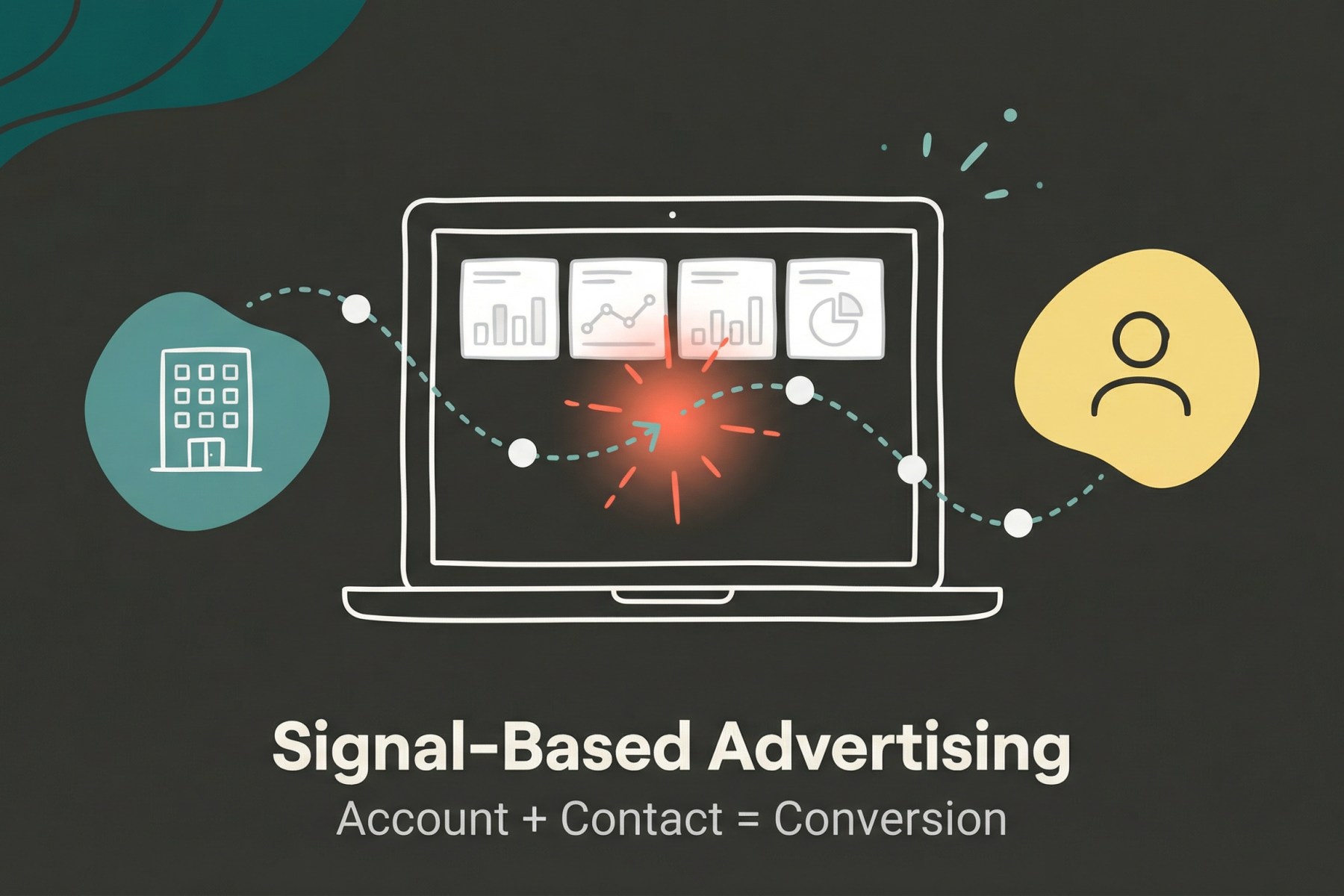
The magic happens at the intersection.
When an account shows company-level readiness AND specific contacts show active research behavior, you have a qualified opportunity. Not a warm lead. An actual buying committee forming in real time.
According to Landbase’s 2026 intent signal analysis, 96% of B2B marketers using intent data report success achieving their goals. The same research shows 93% improvement in conversion rates and 220% higher click-through rates when signal based advertising aligns with active research interests.
This performance gap exists because signal based advertising eliminates a fundamental problem: you’re no longer interrupting people who don’t care. You’re engaging buyers who are already looking for solutions.
Why Most B2B Advertising Wastes 95% of Budget
Only 5% of your total addressable market is actively buying at any given time.
Think about that. If you have 1,000 target accounts, maybe 50 are actually in-market right now. The other 950 aren’t researching. Aren’t comparing vendors. Aren’t forming buying committees.
Traditional advertising sprays budget across all 1,000 accounts equally. You’re paying to reach 950 accounts that won’t buy for another 6-18 months.
Even worse: the 50 that ARE in-market? Every competitor sees the same signals.
Research from DemandScience’s 2026 State of Performance Marketing Report surveyed 750 senior marketing leaders and found 87% report their marketing investments yield unreliable or inflated intent signals. Two-thirds say their dashboards show success metrics that fail to translate into revenue.
This is the marketing data mirage. Your campaigns look productive in the dashboard. Lead volume is up. Engagement is strong. But pipeline stays flat.
Signal based advertising fixes this by focusing resources where account signals and contact signals converge. You’re not chasing every account showing vague interest. You’re prioritizing the small percentage where both company readiness and individual buyer behavior align.

The Signal Convergence Framework
Most B2B companies run either account-based programs OR contact-based programs. Signal based advertising requires both, running in parallel, with concentrated execution where they intersect.
Here’s how the framework works:
Account Signals: Company-Level Indicators
These signals reveal organizational change that creates buying windows:
Funding events signal budget availability. A Series B company that just raised $30M has capital to deploy. Technology changes indicate stack evaluation. If a target account just adopted Salesforce, they’re likely evaluating connected tools. Hiring patterns show team expansion. When a company posts 5 marketing roles in 30 days, they’re scaling fast and need infrastructure.
Growth indicators like new office openings, market expansion announcements, and product launches all create demand for tools and services that support that growth.
Leadership changes matter. A new CMO in their first 90 days is actively evaluating vendors. A new VP of Sales wants to prove impact quickly.
Strategic initiatives announced in earnings calls, press releases, or investor updates telegraph where budget will flow.
Contact Signals: Individual-Level Behavior
While account signals show capability, contact signals show active intent:
Anonymous website visitors become known accounts. Pricing page views indicate bottom-of-funnel interest. Content downloads on specific topics reveal pain points. Email engagement shows message resonance. Response patterns in outbound sequences separate polite replies from genuine interest.
Social engagement matters more than vanity metrics. A VP of Marketing who comments on your LinkedIn post about signal based advertising is worth 100x more than 100 likes from random connections.
Event attendance, especially virtual events and webinars, creates temporal urgency. Someone who registered for your webinar is actively researching NOW, not in Q3.
The Intersection: Qualified Opportunities
When account signals and contact signals align, you have a real opportunity:
In-market account identified. Active buyer showing intent. Buying committee beginning to form. Timeline is immediate, not theoretical.
This is where signal based advertising concentrates budget. Not on the 95% showing weak signals. On the 5% where both signal types confirm buying readiness.
According to ITMunch’s 2026 Signal Surge analysis, B2B purchasing now involves 11-15 stakeholders on average. Single-contact signals create noise. When multiple stakeholders from the same account engage within 48 hours, that’s signal convergence. Everything else is just a click.
How to Build Signal Based Campaigns That Actually Convert
Signal based advertising isn’t a tool. It’s a systematic approach to resource allocation.
Here’s the execution framework:
Step 1: Identify Your Signal Sources
Start with first-party signals before buying expensive third-party data.
Your website visitors are your highest-quality signals. They’ve already found you. Use tools like Clearbit Reveal, 6sense, or Koala to identify which companies are visiting your site, which pages they view, and how often they return.
Your CRM contains historical signals. Which accounts opened emails but didn’t reply? Which contacts downloaded content 6 months ago but went quiet? These are warm signals waiting to be reactivated.
Layer in third-party intent data from Bombora, G2 Buyer Intent, or TechTarget. These platforms track topic-level research across publisher networks. When accounts in your ICP surge on keywords related to your category, that’s an account signal.
Technographic data from BuiltWith or ZoomInfo shows technology stack changes. If your product integrates with Salesforce and a target account just implemented Salesforce, that’s a buying window.
Step 2: Build Segmentation Logic
Not all signals have equal weight. Build a scoring model:
High-propensity signals: Account showing intent + Multiple contacts engaged + Recent activity (last 7 days)
Medium-propensity signals: Account showing intent OR contact engaged + Activity in last 30 days
Low-propensity signals: Single signal type + Activity older than 30 days
Route high-propensity accounts to personalized signal based campaigns. Immediate outreach from sales. Account-specific landing pages. Direct mail to buying committee members.
Medium-propensity accounts get nurture sequences. Retargeting ads. Email sequences triggered by specific behaviors. LinkedIn Sponsored Content to known buying committee members.
Low-propensity accounts stay in awareness programs until signals strengthen.
Step 3: Activate Across Channels
Signal based advertising works across every channel, not just paid media.
LinkedIn ads: Upload high-propensity account lists as matched audiences. Target buying committees with role-specific creative. Use LinkedIn’s Accelerate to automate campaign building based on signal triggers.
Google search: Bid more aggressively on branded and competitor terms for accounts showing active intent. Someone researching “[competitor] vs [your product]” while their account shows funding signals is ready to convert.
Display retargeting: Show account-specific messaging to contacts who visited your pricing page. Different creative for accounts that downloaded a case study versus those who viewed product documentation.
Email: Trigger sequences based on signal combinations. An account showing intent gets generic outreach. An account showing intent PLUS a contact downloading your ROI calculator gets personalized executive outreach.
Outbound: SDRs prioritize accounts with highest signal convergence. Instead of “spray and pray” cold calling, they’re reaching out to accounts where signals confirm active buying behavior.
Signal Based Advertising vs Traditional ABM: What’s the Difference?
Traditional account-based marketing targets accounts based on fit. Signal based advertising targets accounts based on timing.
ABM asks: “Does this account match our ICP?” Signal based campaigns ask: “Is this account actively buying RIGHT NOW?”
You can run both. In fact, you should.
Use ABM for tier 1 accounts (your top 50-100 dream accounts). Build awareness regardless of immediate intent. When one of those accounts starts showing contact signals, shift them into signal based campaigns.
Use signal based advertising for tier 2-3 accounts (your next 500-1000 viable targets). Don’t waste budget building awareness with accounts not in-market. Wait for signals, then strike fast.
The resource allocation looks different too:
Account-based demand creation: Awareness campaigns. Thought leadership. Industry events. Executive engagement. Medium-high investment across all tier 1 accounts.
Signal based demand capture: Retargeting ads. Personalized outbound. Direct mail to active buyers. High investment concentrated on accounts showing convergence.
Most B2B companies overinvest in awareness and underinvest in capture. They’re building preference with 95% of accounts that won’t buy for 12+ months while competitors close the 5% ready to buy today.
The Tools Behind Signal Based Advertising
You need infrastructure to execute signal based campaigns at scale:
Intent data platforms: Bombora, 6sense, Demandbase, G2 Buyer Intent. These identify accounts researching topics related to your solution.
Website visitor identification: Clearbit Reveal, Koala, Warmly. Turn anonymous traffic into known accounts.
Data enrichment: Clay, ZoomInfo, Clearbit. Build buying committee lists and enrich contact records with job changes, company news, and technology signals.
Marketing automation: HubSpot, Marketo, Pardot. Trigger campaigns based on signal combinations. Score leads dynamically as new signals emerge.
Sales engagement: Salesloft, Outreach, Apollo. Route high-propensity accounts to SDRs with context about which signals fired.
Ad platforms: LinkedIn Campaign Manager, Google Ads, Metadata.io. Activate signal based campaigns across paid channels.
The mistake most teams make: buying all the tools before defining the strategy. Start with your signal sources. Build your scoring logic. Then buy the minimum viable stack to activate it.
Measuring Signal Based Advertising Performance
Traditional metrics don’t capture signal based advertising effectiveness.
Don’t measure impressions. Don’t measure clicks. Don’t measure MQLs.
Measure these instead:
Signal-to-opportunity conversion rate: Of accounts showing high-propensity signals, what percentage convert to sales qualified opportunities? Target: 15-25%.
Time from signal to meeting: How fast are you engaging accounts after signals fire? Target: under 48 hours for high-propensity accounts.
Signal accuracy: What percentage of signal-triggered outreach results in meetings versus dead ends? Track which signal combinations predict real opportunities versus noise.
Pipeline velocity: Do signal-sourced opportunities close faster than traditional pipeline? They should. These accounts were already researching before you engaged them.
Win rate by signal strength: Accounts with account + contact signal convergence should close at 2-3x the rate of single-signal accounts.
Feed this data back into your scoring model. If “pricing page view + funding event” converts at 30% but “webinar registration + hiring spike” converts at 8%, weight your scoring accordingly.
The teams winning with signal based advertising treat it as a learning system, not a set-it-and-forget-it tool.
Common Mistakes That Kill Signal Based Campaigns
Buying intent data and treating it like a lead list.
A high-intent account isn’t a warm lead. It’s a company showing research activity. The signal needs context: Who at the company should you contact? What specific problem are they solving? What’s your differentiated angle?
Teams that feed intent signals into generic email cadences see minimal lift. Teams that use signals to time and personalize outreach see 47%+ conversion improvements, according to intent data provider analysis.
Waiting too long to act on signals.
B2B buying cycles are compressed. The window between “actively researching” and “selected a vendor” can be as short as 2-4 weeks for mid-market deals. A signal from 3 weeks ago is noise.
Using signals without sales alignment.
Marketing creates awareness. Sales doesn’t act on it. Wasted effort. Your SDRs need real-time signal notifications, not weekly digest emails. When a tier 1 account shows convergence, sales should be notified immediately.
Ignoring signal decay.
Intent data has a shelf life. Someone researching “email deliverability” today might select a vendor next week. If you’re still nurturing them 60 days later, you’re too late.
Not combining first-party and third-party signals.
Third-party intent shows what accounts are researching across the web. First-party signals show who’s engaging with YOUR content. Layer them. An account showing third-party intent for “marketing automation” while visiting your pricing page 3x this week is ready to buy.
What Signal Based Advertising Means for Your 2026 Budget
If you’re still allocating budget evenly across your entire TAM, you’re burning money.
Signal based advertising concentrates spend where buying is happening. Instead of building awareness with 1,000 accounts, you’re capturing demand from the 50-100 showing active intent right now.
This changes budget allocation:
Reduce spend on broad awareness campaigns targeting cold accounts. Increase spend on retargeting, personalized outbound, and account-specific experiences for signal-qualified accounts.
Shift budget from MQL generation to opportunity acceleration. The goal isn’t more leads. It’s faster conversion of high-intent accounts.
Invest in data infrastructure before creative production. Clean CRM data, integrated intent platforms, and real-time signal activation matter more than another video ad.
According to industry benchmarks, organizations implementing signal based advertising report 30-40% reduction in customer acquisition costs while maintaining or increasing pipeline volume. The efficiency gain comes from eliminating waste, not cutting corners.
How twelfth Implements Signal Based Advertising
We don’t run generic signal based campaigns. We build integrated revenue systems using three strategic frameworks:
Signal Identification & Targeting: We layer first-party website data, third-party intent signals, technographic changes, and buying committee intelligence to identify the intersection where account readiness meets active buyer behavior.
Segmentation & Funnel Design: We run account-based and contact-based funnels in parallel, with concentrated execution at convergence points. Different segments get different treatment based on signal strength and deal complexity.
Demand Creation vs. Demand Capture: We allocate resources across four quadrants – account-based awareness, contact-based education, account-based capture, and contact-based conversion – based on where signals indicate buying readiness.
Execution is AI-native. We use Claude Code to build custom signal processing workflows. We automate account prioritization, buying committee enrichment, and multi-channel activation so your team focuses on conversations, not data management.
The result: predictable pipeline from accounts that were already looking for solutions. Not cold outreach hoping someone bites. Strategic engagement with buyers actively forming opinions.
If your pipeline fluctuates quarter to quarter and you can’t forecast accurately, signal based advertising might be the missing piece. The accounts are already researching. The question is whether you’re engaging them before or after they’ve shortlisted competitors.
Want to see how signal based campaigns would work for your ICP? We’ll audit your current signal sources and show you which accounts in your TAM are showing convergence right now. Book a signal audit here.

"The quality of strategy and dedicated attention we receive is above and beyond. twelfth's modern approach to marketing is completely unique to our needs and quickly unlocked new growth for our business."

"twelfth's modern approach to ABM uncovered several new opportunities for us that will improve our demand gen engine and overall alignment with sales"

"twelfth is a strategic thought partner for us on all things ABM. Steve is well above the typical points of view on the future of ABM and his insights are changing how we approach GTM”

"twelfth's unique use of Clay for ABM target account lists, contact identification, and intent data is awesome. Highly recommend."