The State of Account-Based Marketing
What 771 Marketers Reveal About ROI, AI, and the Path Forward
Account-based marketing (ABM) has reached an inflection point. What started as a specialized tactic for enterprise sales teams has evolved into a core growth strategy for B2B organizations across industries and company sizes. But as adoption accelerates, a critical question emerges: what separates the teams achieving exceptional results from those simply going through the motions?
Outcomes Rocket’s State of ABM 2025 report, based on insights from 771 marketers across diverse industries and organizational sizes, provides the most comprehensive analysis to date of how account-based strategies are performing, where AI is making the biggest impact, and what’s changing as we head into 2026.
ABM Adoption Has Reached Critical Mass
The data confirms what many practitioners have suspected: account-based marketing is no longer experimental. 71.2% of organizations currently implement ABM strategies, representing a shift from niche tactic to mainstream go-to-market approach.
This widespread adoption is driven by measurable results. Organizations report an estimated average ROI of 137% from their ABM programs—effectively returning more than double their investment. Perhaps more telling, 49.2% of organizations cite ABM as delivering their highest ROI compared to any other marketing channel or strategy.
The success metrics extend beyond financial returns. When asked how ABM contributes to marketing success, respondents highlighted:
- Increased revenue (64.1%)
- Better engagement with ideal customers (59.4%)
- Higher win rates (51.5%)
- Increased marketing ROI (51.0%)
- Generation of more qualified leads (48.5%)
- Increased deal size (34.8%)
These outcomes reflect ABM’s ability to drive results across the entire customer lifecycle, from initial engagement through deal closure and expansion. Organizations are backing these results with real investment—allocating an average of 27% of their total marketing budgets to account-based strategies.
The Platform Adoption Paradox
Despite ABM’s proven effectiveness, the technology landscape reveals an interesting paradox. Only 15.3% of organizations currently use a dedicated ABM platform such as Demandbase, 6sense, DemandScience, or RollWorks. The majority (56.1%) instead use a combination of different tools—CRM, marketing automation, and intent data platforms—cobbled together without a unified ABM-specific solution.
This fragmented approach stems from three primary barriers:
Cost remains the dominant constraint (48% of respondents), particularly for mid-market organizations balancing the need for sophisticated capabilities against budget limitations. Dedicated ABM platforms often require six-figure annual commitments that strain already stretched marketing budgets.
Limited internal resources (34.2%) prevent teams from implementing and maintaining complex platform integrations. ABM platforms promise powerful capabilities, but organizations often lack the personnel to configure, optimize, and extract full value from these systems.
Implementation complexity (31.6%) creates additional friction, as teams face lengthy deployment timelines and steep learning curves that delay time-to-value. Many organizations need to demonstrate ROI within quarters, not years.
Among those who have adopted dedicated platforms, Demandbase leads with 40.5% market share, followed by 6sense and ZoomInfo (29.8% each), DemandScience (20.2%), and RollWorks (14.3%). Organizations cite several key drivers for platform adoption: identifying and prioritizing in-market accounts (64.7%), measuring account-level performance and ROI (48.2%), and improving overall marketing efficiency through automation (42.4%).
AI Integration Rampant, Utilization Varies
Artificial intelligence has emerged as the critical differentiator in ABM performance, with 78.7% of organizations incorporating AI into their programs. However, adoption depth varies significantly—only 15.1% report extensive AI usage, while 63.6% use it to a limited extent. This execution gap represents the difference between incremental improvement and transformational results.
The most impactful AI applications cluster around three key areas:
Enhanced targeting and segmentation (48.5% of teams) uses machine learning to analyze patterns across firmographic data, behavioral signals, and intent indicators. Rather than relying solely on basic demographic fits, AI helps identify accounts that exhibit multiple buying signals simultaneously—combining factors like funding events, hiring patterns, technology stack changes, and content consumption to surface accounts with genuine near-term purchase potential.
Increased efficiency in lead engagement (36.4%) optimizes how teams prioritize and interact with target accounts. AI-powered scoring models evaluate account engagement across channels, predict optimal outreach timing, and recommend next-best actions. This enables marketing and sales teams to focus resources on accounts most likely to convert, rather than spreading efforts evenly across all targets.
Campaign content generation (36.2%) accelerates the creation of personalized messaging at scale. Teams use AI to transform core narratives into variations tailored by industry, persona, account stage, and specific pain points. This isn’t about replacing human creativity—it’s about amplifying it, allowing one strategic message to become dozens of contextually relevant variations.
Beyond these primary applications, organizations report using AI for refined buyer persona development (32.1%), enhanced persona segmentation (31.7%), better prediction of deal outcomes (29.0%), and higher win rates through data-driven insights (26.0%).
The impact is measurable: 86.2% of respondents expect AI to boost their ABM ROI over the next year. This optimism reflects early results from teams that have moved beyond basic automation to genuinely intelligent systems that learn, adapt, and improve over time.
The Emergence of ABM 2.0
As traditional account-based marketing matures, a new paradigm is taking shape. While the exact definition varies, “ABM 2.0” generally emphasizes hyper-personalization, cross-channel orchestration, and deeper account intelligence powered by AI and advanced data integration.
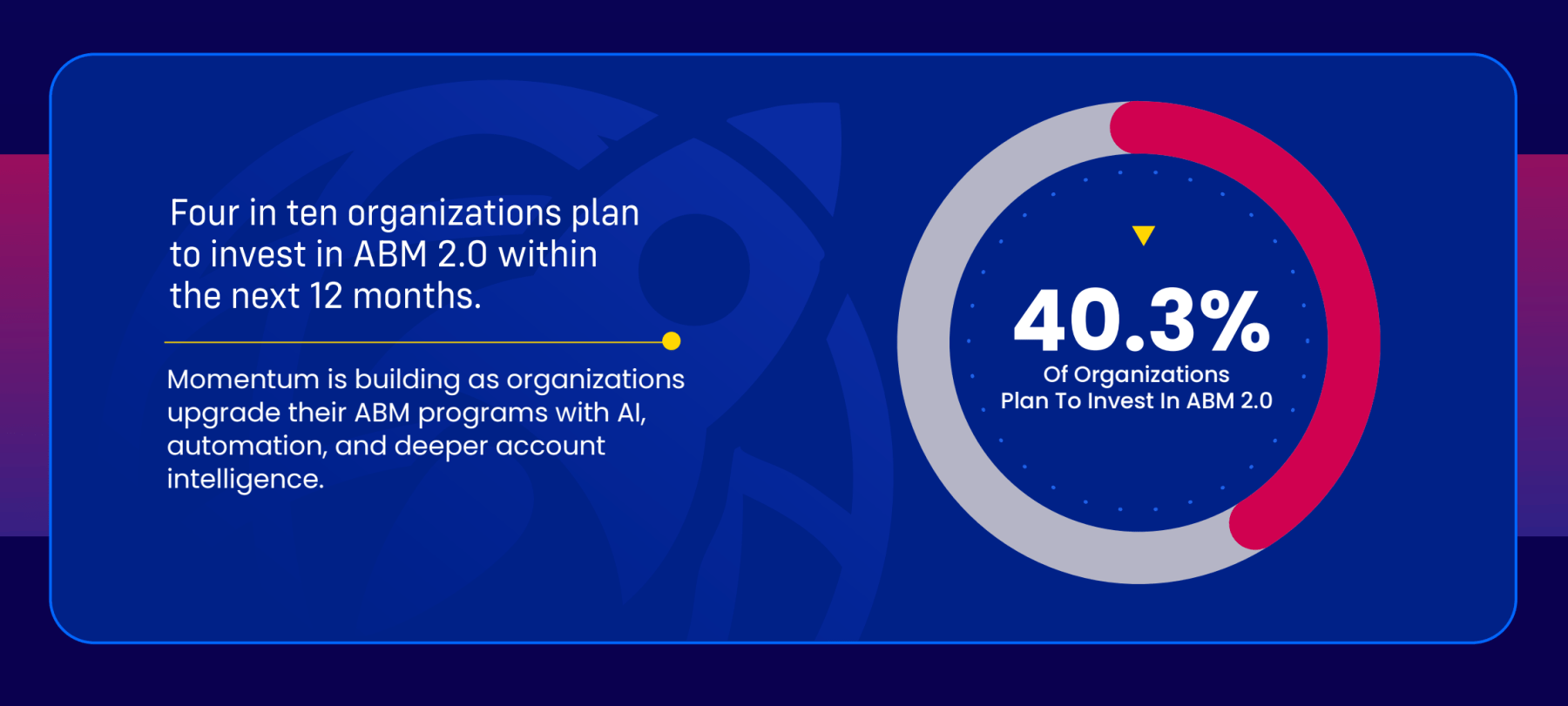
The market is responding: 40.3% of organizations plan to invest in ABM 2.0 capabilities within the next 12 months, signaling significant momentum toward more sophisticated approaches. This transition addresses persistent gaps in current ABM execution—only 17.3% of B2B marketers have fully mapped their customer journeys, and 50.2% struggle to effectively reach the right buying groups within target accounts.
These limitations create expensive inefficiencies. Organizations spend budget on accounts that aren’t in active buying cycles. They engage single contacts when complex B2B purchases require consensus across 6-10 stakeholders. They run disconnected campaigns across email, advertising, and sales outreach that fail to reinforce a cohesive narrative.
ABM 2.0 addresses these challenges through several key evolutions:
Moving from account fit to account readiness: Rather than targeting all accounts that match an ideal customer profile, organizations use real-time signals to identify accounts actively researching solutions, undergoing relevant organizational changes, or exhibiting buying committee formation.
Orchestrating experiences across channels: Every touchpoint—from display advertising to website personalization to sales outreach—tells a consistent, progressive story tailored to where the account sits in their buying process.
Engaging at the buying group level: Understanding not just which companies to target, but which specific individuals within those companies need to be influenced, what content resonates with their roles, and how to coordinate touches across the entire decision-making unit.
Looking Ahead: 2026 Priorities
As organizations plan for the year ahead, their priorities reveal where they believe the greatest opportunities lie. The top expectations for ABM in 2026 include:
- Higher ROI compared to current levels (54.3%)
- Greater integration with AI and automation (51.0%)
- Increased deal sizes and win rates (34.8%)
- Expansion to new markets or accounts (33.7%)
- Adoption of ABM 2.0 practices (28.4%)
- Better engagement with ideal customers (25.3%)
Supporting these ambitions, 49.7% of organizations plan to increase their ABM budgets in 2026, demonstrating sustained confidence in account-based approaches despite broader economic uncertainty.
This investment shows organizations are moving from viewing ABM as a campaign-based tactic to recognizing it as a comprehensive go-to-market operating model. The focus has evolved from simply running targeted programs to building durable systems that align marketing, sales, and customer success around shared account objectives.
What Success Requires
The data reveals clear patterns among high-performing ABM programs. Success correlates strongly with several factors:
Strong data foundations: Organizations achieving superior results invest in unified data models that integrate first-party engagement data, third-party intent signals, and account intelligence. This creates a single source of truth that both marketing and sales can trust and act upon.
Tight sales-marketing alignment: The highest-performing programs feature shared definitions of target accounts, agreed-upon engagement thresholds, and coordinated playbooks for account progression. When marketing and sales operate from the same account lists and success metrics, conversion rates improve measurably.
Sophisticated segmentation: Rather than treating all target accounts identically, leading teams create micro-segments based on signals, industry, account stage, and buying committee composition. This enables relevant personalization at scale rather than generic “one-size-fits-all” messaging.
Continuous optimization: High performers treat ABM as a system requiring constant refinement. They regularly review account engagement patterns, test new messaging approaches, and adjust targeting criteria based on what’s converting versus what’s stalling.
Conclusion: From Adoption to Optimization
The State of ABM 2025 report documents a market in transition. Account-based marketing has proven its value—the ROI is clear, adoption is widespread, and investment is increasing. The question for 2026 isn’t whether to do ABM, but how to do it exceptionally well.
As AI capabilities mature and ABM 2.0 frameworks emerge, the gap between leaders and laggards will widen. Organizations that build strong data foundations, invest in genuine AI capabilities (not just automation), and coordinate experiences across the buying journey will compound their advantages. Those that view ABM as a set of campaigns rather than a strategic operating model will continue to see mediocre results despite increased effort.
The opportunity is significant. With average returns of 137% and nearly half of organizations citing ABM as their top ROI driver, the potential for well-executed account-based strategies is clear. The challenge is moving from adoption to mastery—from checking the ABM box to building systems that consistently identify the right accounts, engage the right people, deliver the right messages, and drive measurable revenue growth.
Download the complete State of ABM 2025 report from Outcomes Rocket for detailed benchmarks, platform comparisons, and comprehensive insights into what’s working in account-based marketing.