

Dark Signals for Signal Based ABM: The 60% of Intent Data You’re Not Capturing
Your signal based ABM platform shows 23 accounts surging on “marketing automation” this month.
Your sales team reaches out. Half don’t respond. A quarter say “not the right time.” Three convert to meetings.
Meanwhile, one of your tier 1 target accounts left a scathing 2-star G2 review of your competitor last Tuesday. They mentioned the exact pain point your product solves. Nobody on your team saw it. Your competitor’s sales rep did.
That’s a dark signal. And you’re missing hundreds of them every week.
Most signal based ABM programs only capture first-party signals (website visits, email clicks) and third-party intent data (Bombora surges, keyword research). Traditional signals for ABM are blind to second-party signals—the behavioral data hiding in systems you already use but don’t monitor for buying intent.
According to research on ABM intent data from Demandbase, only 30% of marketers use third-party intent tools, and just 12% find them useful due to poor signal quality. Meanwhile, the highest-quality signals for ABM are sitting unmonitored in G2 reviews, support ticket sentiment, customer success notes, closed-lost CRM data, and community forum discussions.
This is the 60% you’re not capturing with traditional signal based ABM. Let’s fix it.
What Are Dark Signals in Signal Based ABM?
Dark signals are high-intent buying behaviors that happen outside traditional signal based ABM monitoring systems. They’re called “dark” not because they’re hidden, but because most signal based ABM programs don’t have the infrastructure to detect them.
Traditional signals for ABM taxonomy has three layers:
First-party signals for ABM: Direct engagement with your brand. Website visits, content downloads, demo requests, email opens, webinar registrations. You own this data completely. It’s accurate, privacy-friendly, and immediately actionable for signal based ABM campaigns.
Third-party signals for ABM: Research activity across external publisher networks. Bombora topic surges, 6sense intent spikes, and keyword research patterns. Aggregated from thousands of B2B websites. Useful for early-stage awareness in signal based ABM but often noisy and account-level only.
Second-party signals for ABM: Someone else’s first-party data made available through partnerships or platform access. G2 review activity, community engagement, and support interactions from partner ecosystems.
Most signal based ABM programs stop at first and third-party. The dark signal layer—second-party and latent intent data—goes completely unmonitored in traditional signals for ABM. That’s the 60%.
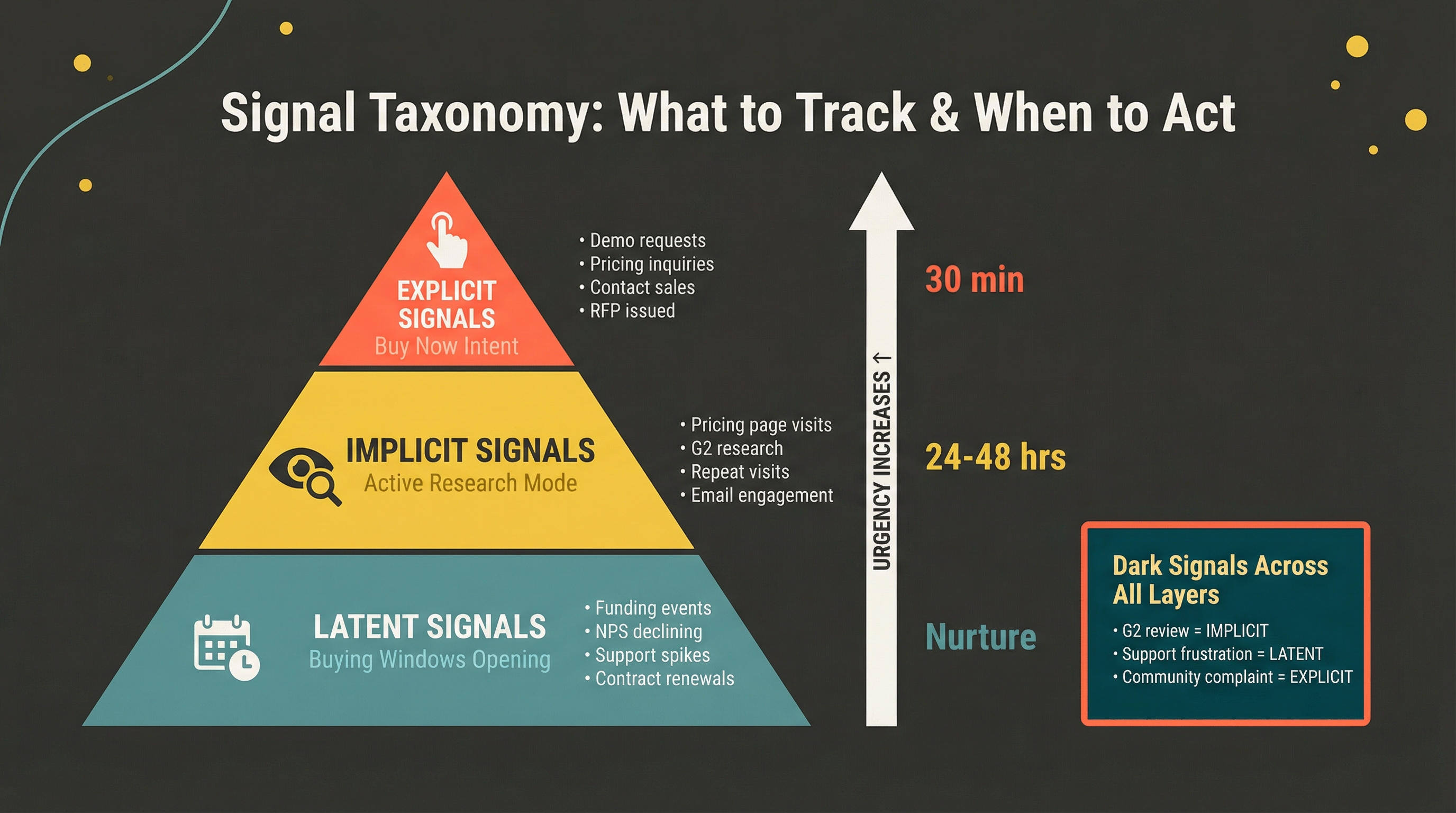
Here’s what you’re missing in your signal based ABM program:
Review platform behavior showing bottom-funnel intent for signal based ABM. When prospects compare your product to competitors on G2, read negative reviews about your competitor, or request demos through review platforms, that’s buying intent stronger than any Bombora surge in traditional signals for ABM.
Support ticket sentiment revealing dissatisfaction with current vendors for signal based ABM targeting. Frustration signals in competitor support tickets predict churn windows. Your competitor’s customer complaining about integration failures is your perfect target account for signal based ABM.
Customer success intelligence exposing expansion and churn signals for ABM. NPS detractors, declining product usage, support escalations, contract renewal timing. These predict buying windows 60-90 days before decisions happen in signal based ABM cycles.
Community forum discussions indicating active problem-solving for signals for ABM. Reddit threads, Slack communities, Stack Overflow questions, LinkedIn group posts. Prospects researching solutions in public forums show authentic, unfiltered intent that traditional signal based ABM misses.
Closed-lost CRM data containing re-engagement triggers for signal based ABM. Why deals died, timing issues, feature gaps, budget constraints. These become reactivation signals for ABM when circumstances change.
Sales call transcripts capturing objections and pain points in signal based ABM. AI sentiment analysis on Gong, Chorus, or Fireflies recordings reveals what’s actually stopping deals. Pattern recognition across calls identifies systematic issues for signals for ABM targeting.
The difference between first/third-party signals for ABM and dark signals: first/third-party signals show someone is researching a category in signal based ABM. Dark signals show someone is unhappy with their current solution and actively evaluating alternatives.
One indicates interest. The other indicates urgency for signal based ABM activation.
Why Most Signal Based ABM Programs Are Blind to 60% of Intent
It’s not that these signals for ABM don’t exist. It’s that signal based ABM infrastructure isn’t wired to capture them.
Here’s why your signal based ABM program is missing dark signals:
Signal fragmentation across non-marketing systems. G2 data lives in review platform dashboards. Support ticket sentiment sits in Zendesk or Intercom. Customer success notes hide in Gainsight or ChurnZero. Closed-lost reasons exist as unstructured text fields in Salesforce. Community discussions happen on platforms your signal based ABM team doesn’t monitor.
Nobody’s aggregating these signals for ABM into a unified view. Your marketing automation sees website visits. Your intent data platform sees topic surges. But neither sees the G2 review or the support ticket pattern that actually predicts buying readiness in signal based ABM programs.
Organizational silos prevent cross-functional signal sharing in signal based ABM. Marketing owns first-party and third-party intent data. Customer success owns churn signals and NPS. Support owns ticket sentiment. Sales owns call transcripts and closed-lost reasons. Product owns community feedback.
Each team monitors their own signals for ABM independently. Nobody connects them for signal based ABM. A target account showing Bombora intent + declining NPS + support escalation + competitive G2 research is a tier 1 opportunity. But marketing only sees the Bombora spike in their signal based ABM platform. Customer success only sees the NPS decline. Nobody sees the convergence that makes signals for ABM powerful.
Dark signals require manual discovery in signal based ABM. Traditional signals for ABM come from platforms designed for signal detection. Bombora automatically identifies topic surges. Clearbit reveals website visitors. G2 Buyer Intent sends account-level alerts for signal based ABM programs.
Dark signals for ABM require active monitoring. Someone has to read G2 reviews manually. Someone needs to analyze support ticket themes. Someone must parse closed-lost reasons for patterns in signal based ABM. That manual work doesn’t scale in traditional signal based ABM programs, so it doesn’t happen.
Attribution complexity makes dark signals for ABM seem less valuable. First-party signals have clean attribution in signal based ABM. Demo request → meeting booked → deal closed. Easy to measure ROI in traditional signals for ABM.
Dark signals for ABM have messy attribution. Account left negative G2 review about competitor in January. Sales reached out in March using signal based ABM. Deal closed in June. Which touchpoint gets credit in your signal based ABM program? Attribution models struggle with dark signals for ABM, so teams focus on signals with cleaner tracking.
Privacy and data access constraints limit signals for ABM. Review platforms don’t make all behavioral data public. Support systems from other vendors aren’t accessible for signal based ABM monitoring. Community discussions require monitoring tools most teams don’t have. The infrastructure to capture dark signals at scale doesn’t exist in most signal based ABM stacks.
According to research on ABM personalization from Recotap, the gap between what marketers call “personalized” and what buyers experience is massive. Most B2B buyers say personalized content they receive is still too generic to be useful. That’s because personalization based only on first/third-party signals for ABM misses the context dark signals provide in signal based ABM.

Dark Signal Source 1: G2 and Review Platform Intelligence for Signal Based ABM
Review platforms offer the strongest second-party intent signals for ABM available. When prospects research software on G2, TrustRadius, Capterra, or Gartner Peer Insights, they’re deep in evaluation mode for signal based ABM targeting.
According to research from Demandbase on G2 intent signals, review platform signals are inherently purchase-related because people on G2 are evaluating software, not casually browsing. These are bottom-of-funnel signals for ABM programs.
Here’s what to track in your signal based ABM program:
Category research activity for signals for ABM. Accounts viewing your category page, comparing solution types, reading “best of” lists. This shows early-stage problem awareness in signal based ABM. They know they need a solution but haven’t shortlisted vendors yet.
Competitor profile visits as signals for ABM. When target accounts view competitor profiles, that’s active evaluation in signal based ABM. They’re building a shortlist. If they’re researching your top three competitors, you should be in that conversation with your signal based ABM program.
Your profile engagement for signal based ABM. Views, demo clicks, feature comparisons, pricing inquiry, review reads. Direct engagement with your G2 profile indicates strong consideration in signals for ABM. These accounts are further along than generic intent surges in traditional signal based ABM.
Negative reviews of competitors – the dark signal goldmine for signal based ABM. When someone from your target account leaves a 2-star review of your competitor mentioning specific pain points, that’s a buying signal disguised as feedback. Mine competitor reviews for patterns in your signal based ABM program: integration failures, poor support, missing features, pricing complaints, slow implementation.
Comparison activity timing matters in signal based ABM. An account comparing three vendors in your category over two weeks shows active procurement. Speed matters in signals for ABM. According to research from Directive Consulting on ABM timing, teams acting on intent spikes within 24 hours see 29% lift in opportunity creation compared to slower responders in signal based ABM.
The advantage of G2 signals over Bombora surges in signal based ABM: G2 shows you exactly what prospects are comparing, which features they care about, and what frustrates them about competitors. Bombora tells you someone at the account researched “marketing automation.” G2 tells you they read negative reviews about your competitor’s email deliverability and clicked your integrations page for signal based ABM targeting.
One is directional for signals for ABM. The other is actionable in signal based ABM.
Dark Signal Source 2: Support Ticket Sentiment and CS Intelligence for Signal Based ABM
Your customer success and support teams sit on the most predictive churn and expansion signals for ABM in your business. But most signal based ABM programs treat CS data as “post-sale” and ignore it entirely for signals for ABM targeting.
Mistake. Massive mistake for signal based ABM.
Here’s why: churn signals from existing customers reveal market patterns for signal based ABM. If 12 customers churned this quarter citing “poor Salesforce integration,” that’s not just a retention problem. That’s market intelligence for signals for ABM.
Every competitor’s customer experiencing that same pain point is a qualified prospect for your signal based ABM program. Your support tickets are showing you what to sell and who to sell it to in signal based ABM.
According to research from Pylon on support ticket intelligence, support tickets mentioning onboarding confusion, repeated billing problems, or feature gaps predict cancellation within 60-90 days. Sentiment analysis on support tickets surfaces the pattern faster than waiting for quarterly NPS declines in signal based ABM programs.
For your existing customer base in signal based ABM, CS intelligence reveals expansion signals for ABM:
NPS promoters (9-10 scores) discussing specific features. High NPS customers who love specific capabilities signal product-market fit for signal based ABM. Similar companies probably have the same need. Use NPS verbatims to identify expansion segments in signals for ABM targeting.
Support ticket themes revealing adjacency opportunities for signal based ABM. If customers keep requesting “advanced reporting” in your signal based ABM program, that’s not a feature request—it’s a market signal. Build it, then target similar accounts who need it using signals for ABM.
Usage pattern changes indicating lifecycle shifts in signal based ABM. Customers doubling usage quarter-over-quarter show expansion potential. Similar accounts at similar growth stages become qualified targets for your signal based ABM program.
Contract renewal windows from account mapping for signals for ABM. Competitor customers with renewal dates in 60-90 days become tier 1 targets in signal based ABM. Reach out 30 days before renewal with comparison content using signals for ABM intelligence.
According to research from Pedowitz Group on churn prediction, AI models combining support data with engagement metrics achieve 85-92% accuracy in predicting churn risk. When NPS drops 10+ points AND support tickets increase 30% in the same quarter, churn probability exceeds 70% in signal based ABM analysis.
The same model works in reverse for competitor accounts in signal based ABM. High support volume + declining sentiment + renewal approaching = qualified target for signals for ABM activation.
Dark Signal Source 3: Closed-Lost CRM Data as Reactivation Signals for ABM
Your CRM contains hundreds of qualified accounts that said “no” at some point in your signal based ABM program. Most teams treat closed-lost as dead for signals for ABM. They’re not dead. They’re dormant in signal based ABM.
Closed-lost reasons are reactivation signals for ABM. Someone told you exactly why they didn’t buy in your signal based ABM program. When those circumstances change, they become qualified again for signals for ABM targeting.
Common closed-lost reasons that create reactivation windows in signal based ABM:
“Timing/not ready” (accounts not in buying window for signal based ABM). They had the problem. They liked the solution. But procurement was frozen, budget was allocated elsewhere, or internal priorities shifted in your signal based ABM program. These aren’t “no forever” decisions in signals for ABM. They’re “no right now.”
Reactivation trigger for signal based ABM: Time. Set automated reengagement 6 months, 9 months, 12 months post-close in your signal based ABM program. Check if circumstances changed for signals for ABM targeting.
“Missing feature X” (product gaps in signal based ABM). They needed a capability you didn’t have at the time in your signal based ABM program. If you’ve since built it, they’re qualified again for signals for ABM activation.
Reactivation trigger for signal based ABM: Product launch. When you ship the missing feature, notify everyone who closed-lost for that reason using signals for ABM intelligence. Subject line: “You asked for [Feature]. We built it.”
“Went with competitor X” (lost competitive deal in signal based ABM). They chose someone else in your signal based ABM program. But vendor satisfaction isn’t permanent for signals for ABM. Contracts renew. Expectations aren’t met. Promised features never ship.
Reactivation trigger for signal based ABM: Competitor contract renewal dates (typically 12-month cycles), negative G2 reviews about the competitor, competitive product issues in signals for ABM monitoring (monitor release notes, outage reports).
Dark Signal Source 4: Community Forum and Social Intelligence for Signal Based ABM
B2B buyers research solutions in communities long before they visit vendor websites for signal based ABM evaluation. Reddit, Hacker News, industry Slack groups, LinkedIn communities, Stack Overflow, Discord servers, Quora.
These discussions reveal authentic, unfiltered buying intent for signal based ABM. Nobody asks “What’s the best marketing automation for Series A SaaS companies?” on Reddit for fun. They’re researching solutions for signals for ABM targeting.
According to research from Demandbase on intent signals, buyers often seek peer recommendations in niche Slack groups, Reddit communities, and professional circles. These community discussions show intent without vendor bias in signal based ABM programs.
What to monitor in your signal based ABM program:
Solution recommendation requests for signals for ABM. “Looking for alternatives to [Competitor]” or “Best tools for [Use Case]” posts. These are active buyers building shortlists for signal based ABM targeting.
Pain point discussions for signal based ABM. People venting about current tool limitations. “Anyone else frustrated with [Competitor]’s lack of [Feature]?” These signal dissatisfaction and openness to alternatives in signals for ABM programs.
Vendor comparison threads for signal based ABM. “[Tool A] vs [Tool B]” discussions show buying committees researching options. If you’re not mentioned in signals for ABM conversations, inject yourself (authentically).
The challenge in signal based ABM: community signals are high-intent but unstructured for signals for ABM. Someone on Reddit isn’t going to fill out a demo form. They’re researching anonymously for signal based ABM evaluation.
How twelfth Mines Dark Signals for Client Signal Based ABM Programs
We don’t run traditional ABM. We run signal based ABM that captures all three layers: explicit, implicit, and latent signals for ABM.
Most agencies stop at Bombora + website visitor ID in their signal based ABM programs. We go deeper with signals for ABM.
Here’s our dark signal mining framework for signal based ABM:
Layer 1: Second-Party Signal Aggregation for Signal Based ABM
We connect G2 Buyer Intent, support ticket sentiment analysis (for clients’ own CS data), closed-lost CRM mining, and community monitoring into unified signal feeds for signal based ABM. Every dark signal source pipes into one dashboard alongside traditional first/third-party intent in our signals for ABM platform.
This creates complete account intelligence for signal based ABM. Not just “Company X is researching marketing automation.” Full context in signals for ABM: “Company X researched marketing automation (Bombora), read negative HubSpot reviews about deliverability (G2), has contract renewal in 60 days (CRM), and posted on Reddit asking for alternatives (community). Also: their marketing team grew 40% last quarter (hiring signal).”
That’s actionable for signal based ABM. That’s tier 1 in signals for ABM targeting.
Layer 2: Signal Convergence Scoring for Signal Based ABM
We apply the Signal Convergence Framework in our signal based ABM programs: account signals (funding, hiring, tech adoption) + contact signals (website visits, G2 activity, email engagement) + dark signals (support frustration, review activity, community discussions) create comprehensive signals for ABM scoring.
Accounts showing convergence across all three layers get tier 1 prioritization in signal based ABM. Accounts with only traditional signals get tier 2/3 treatment in our signals for ABM program.
The scoring model weights dark signals heavily in signal based ABM because they indicate dissatisfaction with current state, not just category research for signals for ABM. Someone researching “marketing automation” might be in discovery mode for 6 months. Someone complaining about their current tool on Reddit is ready to switch now in signal based ABM.
Layer 3: Real-Time Dark Signal Alerts for Signal Based ABM
When tier 1 accounts show dark signals in our signal based ABM program, client SDRs get Slack alerts with full context for signals for ABM: “Acme Corp (tier 1) just left 2-star G2 review of HubSpot citing email deliverability issues. Contract renewal: Q3. Buying committee: 3 stakeholders identified. Recommended play: Email deliverability comparison campaign + direct outreach from AE.”
Not weekly digest emails in signal based ABM. Real-time alerts that enable same-day activation while intent is hot for signals for ABM programs.
A recent client example in signal based ABM: We identified 47 accounts showing dark signals (G2 competitive research + support frustration + renewal windows). Traditional ABM scored these as tier 2/3 based on firmographics alone. Dark signal analysis elevated them to tier 1 in our signal based ABM program.
Results in signals for ABM: 31 of 47 (66%) converted to meetings within 90 days in our signal based ABM program. 12 closed deals. 4.2x higher conversion than traditional intent-only ABM campaigns using standard signals for ABM.
The difference in signal based ABM: we weren’t reaching out to accounts “researching solutions.” We reached out to accounts actively unhappy with their current vendor and evaluating alternatives using comprehensive signals for ABM. Timing beats everything in signal based ABM.
Building Your Dark Signal Monitoring System for Signal Based ABM
You don’t need enterprise ABM platforms to capture dark signals for signal based ABM. You need structured processes and the right lightweight tools for signals for ABM monitoring.
Here’s how to start your signal based ABM program with dark signals:
Week 1-2: Identify Your Highest-Value Dark Signal Sources for Signal Based ABM
Don’t try to monitor everything in your signal based ABM program. Start with one or two high-impact sources for signals for ABM:
If you’re in SaaS with G2 presence: Start with G2 Buyer Intent + competitor review monitoring in your signal based ABM program. If your customers have high support volume: Start with CS/support sentiment analysis for signals for ABM. If you have strong closed-lost data: Start with CRM reactivation signals in signal based ABM. If your market is active on Reddit/communities: Start with community monitoring for signals for ABM.
Pick one for your signal based ABM program. Prove it works for signals for ABM. Then add more.
Week 3-4: Set Up Monitoring Infrastructure for Signal Based ABM
For G2 signals in your signal based ABM program: Subscribe to G2 Buyer Intent (if applicable). Set up manual competitor review monitoring (30 min weekly) for signals for ABM. Create Slack channel for G2 alerts in signal based ABM.
For support/CS signals in signal based ABM: Export NPS data monthly for signals for ABM. Run sentiment analysis on support tickets (Zendesk AI, Intercom, or manual tagging) in your signal based ABM program. Tag churn reasons structurally in CRM for signals for ABM tracking.
For closed-lost signals in signal based ABM: Clean CRM closed-lost data for signals for ABM. Standardize close reasons (dropdown, not free text) in your signal based ABM program. Build segments by close reason for signals for ABM. Set reactivation cadences (6/9/12 month touches) in signal based ABM.
Week 5-6: Connect Dark Signals to Signal Based ABM Workflow
Create routing rules in your signal based ABM program: G2 competitive research → SDR alert + email sequence for signals for ABM. Support frustration pattern → technical champion outreach in signal based ABM. Closed-lost + reactivation trigger → AE personalized video for signals for ABM. Community complaint → content response + retargeting ad in signal based ABM.
Don’t build complex automation on day one in your signal based ABM program. Start with manual alerts to prove signal quality for signals for ABM. Then automate what works in signal based ABM.
Week 7-12: Measure and Iterate Your Signal Based ABM Program
Track dark signal conversion metrics in signal based ABM: Signal-to-meeting rate for signals for ABM. Signal-to-opportunity rate in your signal based ABM program. Time from signal detection to activation for signals for ABM. Dark signal sourced revenue in signal based ABM.
Compare to traditional signal performance in your signal based ABM program. If G2 review signals convert at 18% and Bombora surges convert at 3% in signals for ABM, double down on G2 in your signal based ABM program.
The most important metric in signal based ABM: speed. Dark signals decay faster than traditional intent for signals for ABM. G2 review activity has a 7-14 day half-life in signal based ABM. Support frustration peaks have 30-60 day windows for signals for ABM. Act fast or signals die in signal based ABM.
Why Dark Signals Are the Future of Signal Based ABM
Traditional ABM is hitting saturation. Everyone uses Bombora in their signal based ABM programs. Everyone tracks website visitors for signals for ABM. Everyone monitors LinkedIn engagement in signal based ABM.
When everyone has the same signals for ABM, nobody has an advantage in signal based ABM. Competition shifts to who acts fastest and personalizes best using signals for ABM.
Dark signals create differentiation in signal based ABM. Your competitors aren’t monitoring G2 reviews manually for signals for ABM. They’re not mining support ticket sentiment in their signal based ABM programs. They’re not tracking community discussions for signals for ABM. They’re running the same playbook everyone else runs in traditional signal based ABM.
Meanwhile, you’re reaching out to accounts showing dissatisfaction with current vendors before they even start active evaluation using dark signals in signal based ABM. You’re engaging closed-lost accounts when circumstances change for signals for ABM. You’re activating community discussions into pipeline using comprehensive signal based ABM.
That’s unfair advantage in signal based ABM. That’s the 60% they’re missing in signals for ABM.
The teams winning signal based ABM in 2026 don’t just have better platforms for signals for ABM. They have better signal coverage in signal based ABM. They see what others don’t in signals for ABM. They act when others wait in signal based ABM.
Start mining dark signals in your signal based ABM program. The data is already there for signals for ABM. You just need to look.
Your pipeline depends on signal based ABM. Your competitive advantage depends on comprehensive signals for ABM.

"The quality of strategy and dedicated attention we receive is above and beyond. twelfth's modern approach to marketing is completely unique to our needs and quickly unlocked new growth for our business."

"twelfth's modern approach to ABM uncovered several new opportunities for us that will improve our demand gen engine and overall alignment with sales"

"twelfth is a strategic thought partner for us on all things ABM. Steve is well above the typical points of view on the future of ABM and his insights are changing how we approach GTM”

"twelfth's unique use of Clay for ABM target account lists, contact identification, and intent data is awesome. Highly recommend."